

- INTERNATIONAL YACHTING MAGAZINE
TAG Heuer Monza Flyback, fifty years of speed on the wrist
The TAG Heuer Monza Flyback Chronograph returns in forged carbon with the COSC-certified TH20-12 movement, flyback function and a limited production of 500 pieces
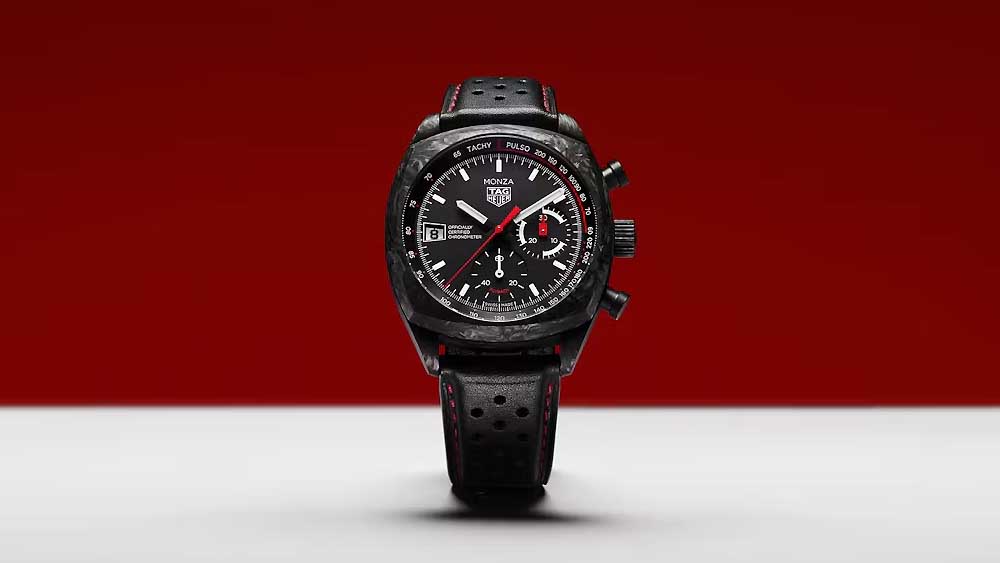
Born in 1976 from Heuer’s connection with motorsport, the Monza now interprets its history through carbon, red accents and a flyback chronograph
The TAG Heuer Monza Flyback Chronograph carries the name of a racetrack, but above all almost fifty years of connection between watchmaking and motorsport. Introduced in 1976, the Monza was never the most understated chronograph in the Heuer family: black, red and a strong instrument-inspired character were already fundamental elements of its identity.
The new CR5092.FC8372 reference retains those elements without attempting to reconstruct the past. Instead, it brings them into another era, using forged carbon, a contemporary flyback movement and a construction that interprets the sports chronograph through modern materials and performance.
Monza, a name born on the racetrack
The story begins in 1975, when Ferrari won both the Formula 1 Constructors’ and Drivers’ World Championships with Niki Lauda. Heuer was the Scuderia’s technical partner at the time, providing timing systems used in development and track activity.
The following year saw the arrival of the Heuer Monza, created to celebrate that achievement and named after the Italian circuit where Lauda had mathematically secured the world title.
It was also an important model from a design perspective. The Monza introduced a black-coated case for Heuer, combined with a dark dial, red details and luminous indications. Its appearance was closely related to the visual language of racing instruments of the period and would influence other chronographs from the brand in subsequent years.
The black remains, the material changes
Fifty years later, black remains an essential part of the Monza’s identity, but the way it is achieved has changed completely.
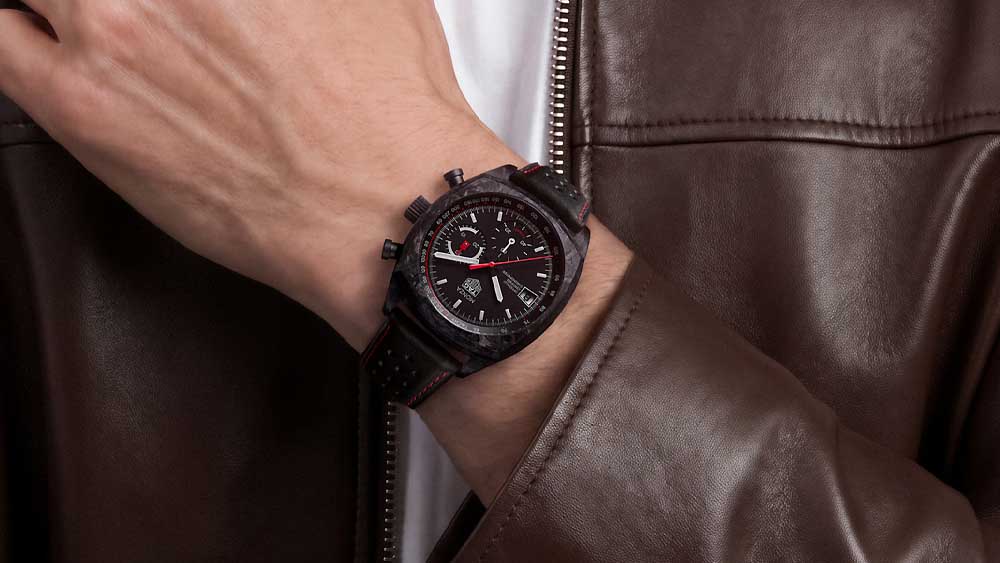
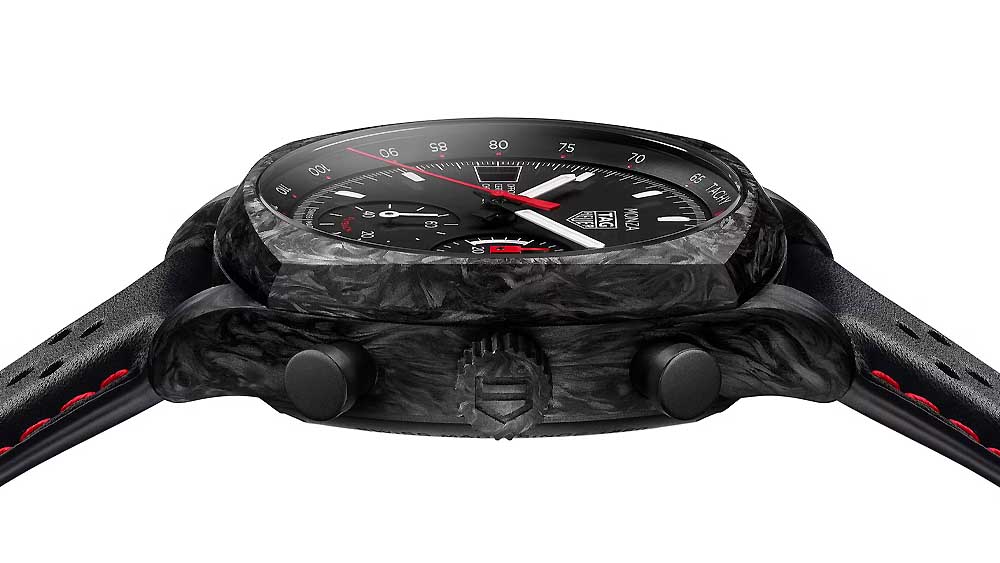
The new 42 mm case and bezel are made from forged carbon, a material that helps reduce weight while creating an irregular visual texture that varies from one piece to another.
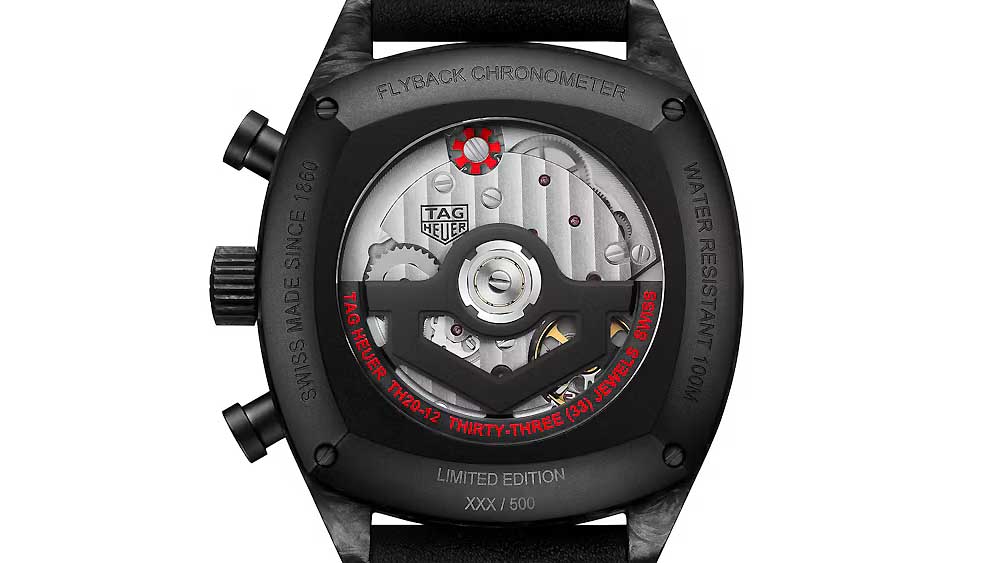
The case is 15.22 mm thick, while the caseback is made from grade 5 titanium with a black PVD coating. Water resistance is rated to 100 metres.
This is therefore a Monza that remains recognisable through its black and red contrast, without becoming a simple visual reproduction of the 1976 watch.
A dial designed like an instrument
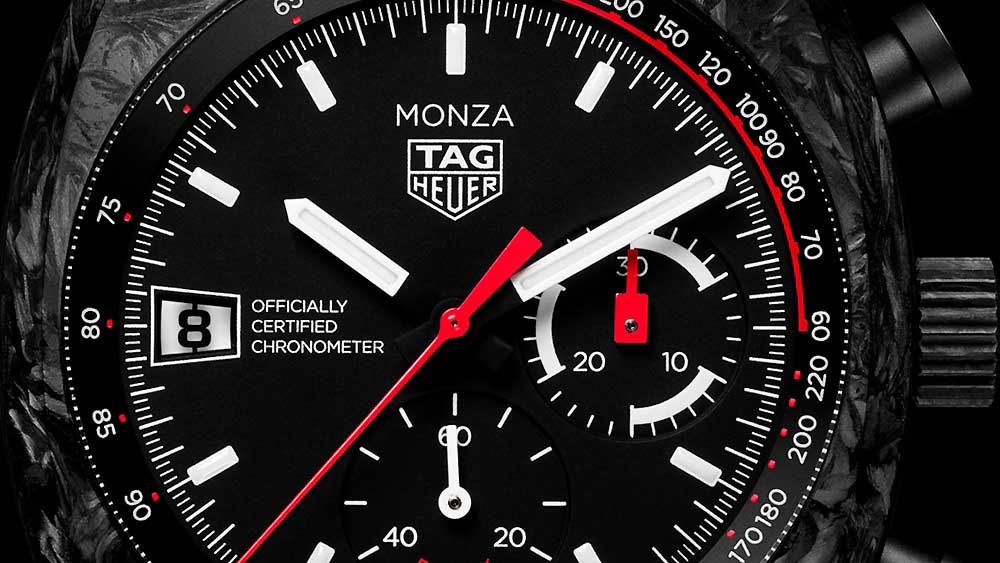
The matte black dial carries a considerable amount of information without disguising the technical nature of the watch.
The flange combines a tachymeter and pulsometer scale, while red accents highlight selected elements associated with time measurement. Two subdials display chronograph minutes and running seconds.
The indexes use white Super-LumiNova®, while white lacquered hands provide strong contrast against the dark background.
The design therefore remains closely connected to the idea of an instrument, without literally imitating the dashboard of a racing car.
Flyback, when stopping is unnecessary
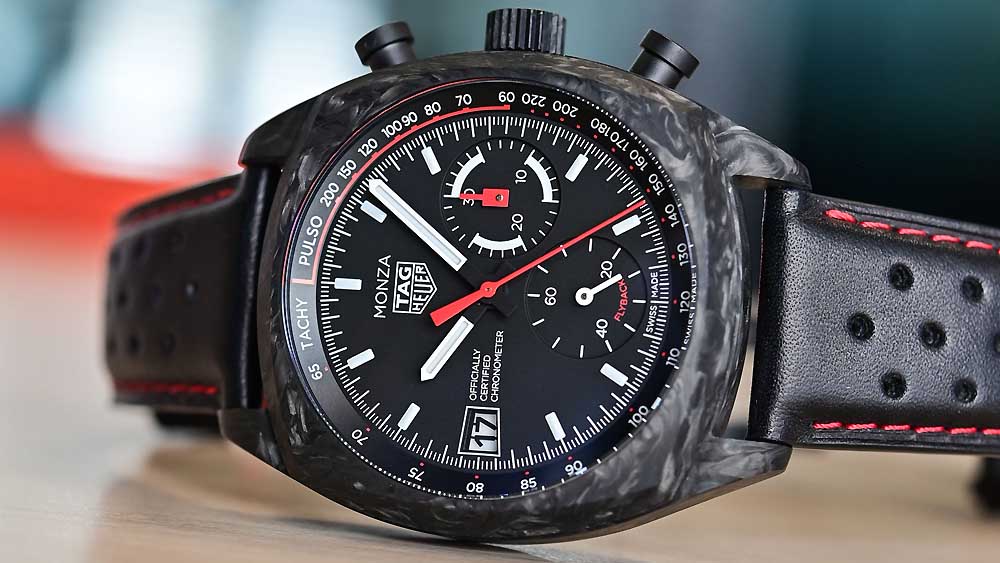
The defining technical feature of this version is the flyback chronograph.
With a conventional chronograph, starting a new measurement requires stopping, resetting and restarting the mechanism. A flyback combines those operations into a single action: the chronograph resets and immediately begins timing again.
It is a complication developed for consecutive measurements and therefore particularly appropriate for a watch whose identity remains closely linked to motorsport.
In the Monza, the function is provided by the Calibre TH20-12 COSC Flyback, an automatic in-house movement operating at 28,800 vibrations per hour, or 4 Hz.
Eighty hours away from the wrist
The TH20-12 provides an 80-hour power reserve. The watch can therefore remain unworn for more than three days without the movement stopping.
COSC certification adds chronometric control, while the flyback function focuses attention on the immediate timing of consecutive intervals.
These may not be features every owner uses on a daily basis, but they reinforce the relationship between function and identity that separates a mechanical chronograph from an object merely styled around the world of racing.
A strap that continues the automotive language
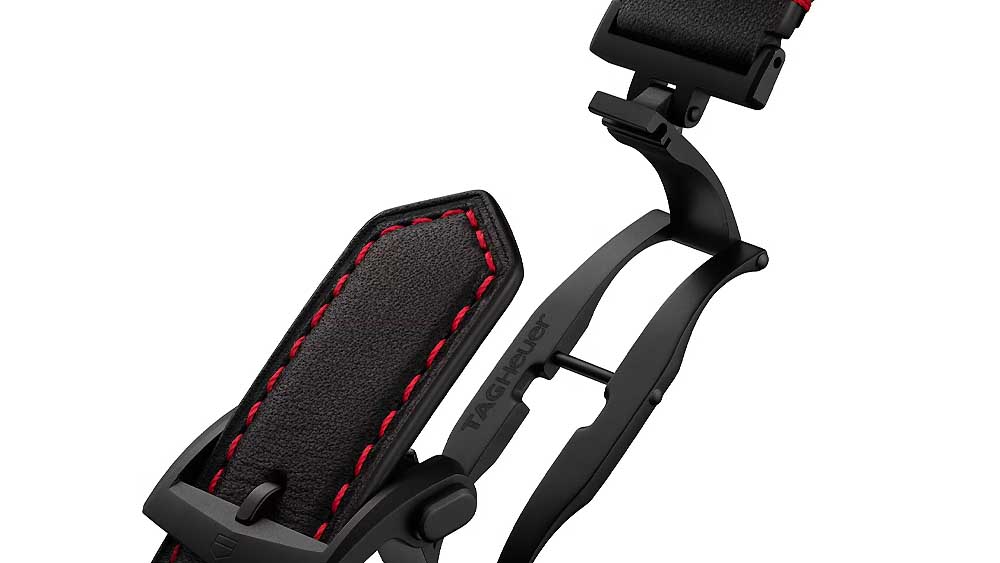
The strap is made from perforated black leather, deliberately recalling details traditionally associated with automotive equipment.
It is paired with a sandblasted folding clasp with double safety push-buttons and a black DLC coating.
Once again, there is no need for automotive logos or explicit references. The connection with racing is conveyed through materials, textures and colour combinations that are already sufficiently recognisable.
Fifty years without becoming vintage
The 1976 Monza celebrated a specific moment in Formula 1 history. The 2026 model faces a different choice: simply remember that history, or use it as a starting point.
TAG Heuer has chosen the latter.
Forged carbon, the TH20-12 movement, flyback functionality and contemporary proportions move the new Monza away from the idea of a faithful re-edition. What remains is the black, the red, the name and, above all, a relationship with measuring time that has belonged to the model from the beginning.
Production is limited to 500 pieces.
Perhaps that balance is what makes the Monza interesting today. It does not try to look like a 1976 watch preserved unchanged for fifty years. Instead, it asks what the Monza might be if it were designed today while retaining the same desire to speak about speed.
__
TAG Heuer
11 September 2026
© Y-MAG Editorial Team
TAG Heuer Monza Flyback, fifty years of speed on the wrist
__
The information in this article has been sourced from and adapted from official sources and/or press releases, in accordance with our editorial code of ethics.
MED digital publishing
Via Giosué Carducci, 10
00187 Roma IT
CONTACTS
+39.06.5654.8962 phone
+39.338.146.1476 infoline
media@med.it.



MED digital publishing
Via Giosué Carducci, 10
00187 Roma IT
CONTACTS
+39.06.5654.8962 phone
+39.338.146.1476 infoline
media@med.it.
Privacy and Cookies (GDPR)
© MED Y-MAG International Yachting Magazine. All rights reserved.